
Today we are in Santarem, which is one of the major cities on the Amazon.  This will be the last stop on this massive river.  For more information on this area click here: http://en.wikipedia.org/wiki/Tapaj%C3%B3s.

One of the reasons we booked this circle South America cruise was to get the opportunity to check off some of our “bucket” list items.  Margaret wanted to see Machu Picchu…I wanted to go to Antarctica and the Amazon.  One of the things I really wanted to do on the Amazon was to fish for piranha!  My brother is into fishing big-time…it is one of his favorite activities.  I thought this was something I could do for him so he could vicariously experience this unique opportunity through me.

So, in an attempt to fulfill my bucket list, we decided to take the River Tour and Eco Maica Lake excursion, which listed “piranha fishing” as one of the activities on the tour.
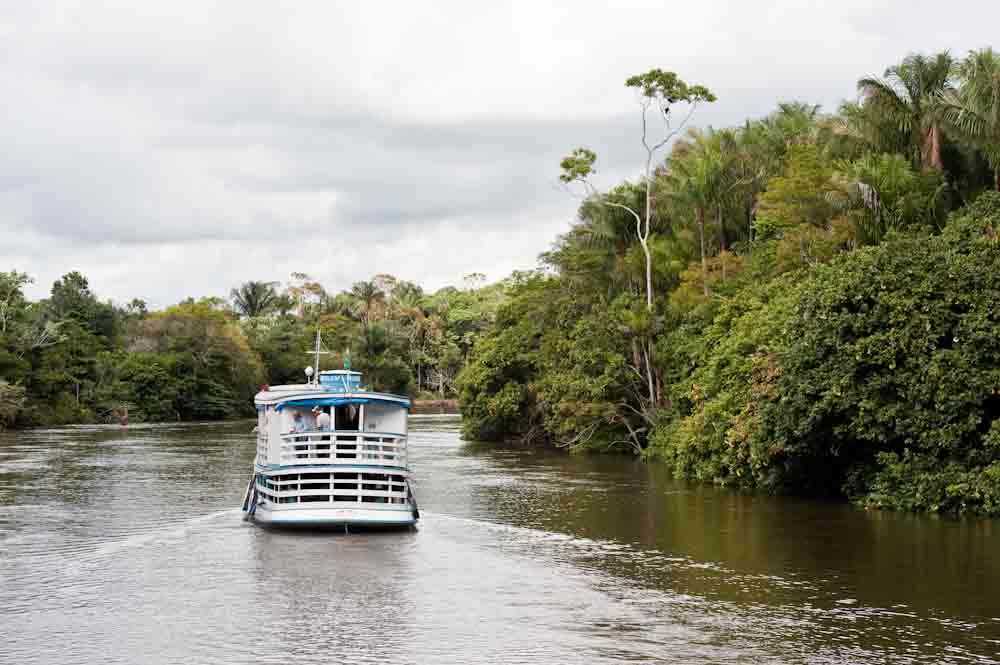
We arrived at the dock at about 7:30 am and boarded the river boat for our ride up the Tapajós River to see their version of the Meeting of the Waters – here the Tapajós River (black) meets the Amazon (whitish-brown) – because they are different temperatures, densities and pH levels — the water takes a while to mix together. The locals like the darker water because it is a less hospitable environment for mosquitoes and it is also better to use for showers, washing dishes, etc.  The native Indians drink the river water…but our guide told us we shouldn’t try it.  No problem there – we’ve got plenty of bottled water from the ship!

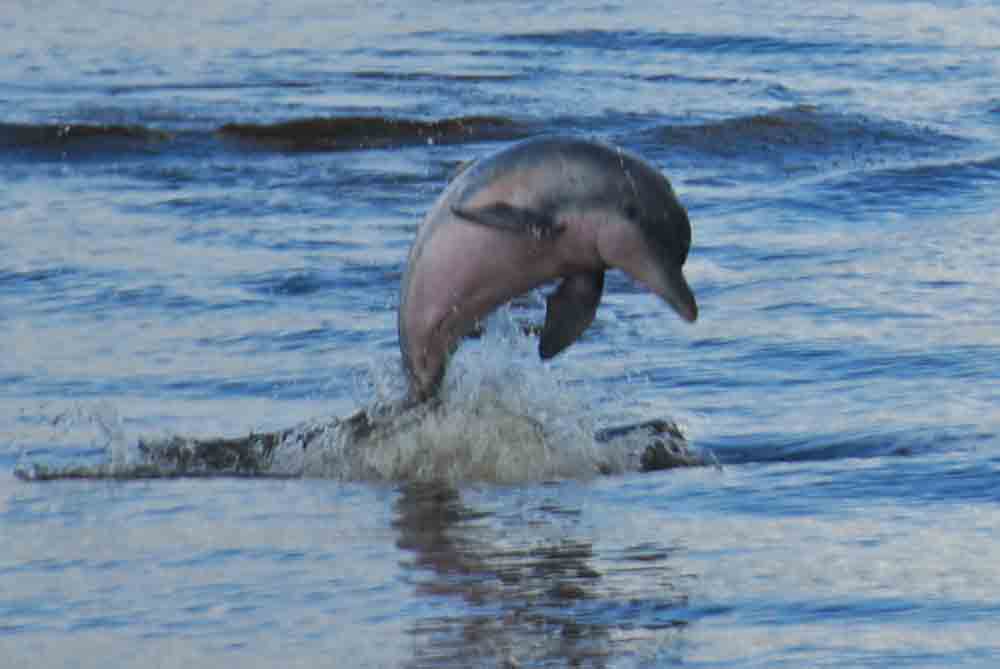
We had some friendly dolphins playing near the boat as we crossed the lake and we were able to get some great action shots of them jumping and playing.
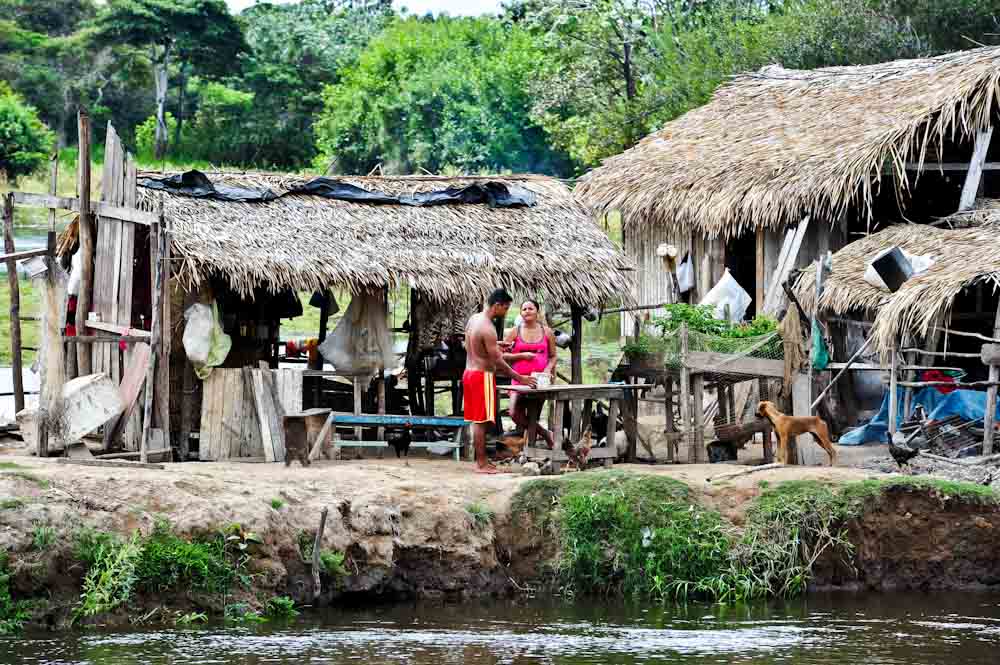
After we traversed the lake, we went down a tributary and got a glimpse into how the locals live.  Most of the houses here are built on stilts as the river rises at various levels throughout the wet season.  Those living along the riverbank spend their time fishing and raising water buffalo, chickens and children.  It seems most of these folks have 6 or more offspring — our guide said they don’t have electricity, so that means no television which equals lots of children!
We even saw a herd of water buffalo cross the river — that was quite a sight!

Finally we arrived at the location where we would start fishing.  We baited our hook with some raw pork and then dropped our fishing lines into the water.   And, as is typical with fishing…we wait…and wait.  Finally someone at the other end of the boat starts to shout “I got one!  I got one!”.  We all ran to see what he caught and it looked like it was a blue gill!   We really thought it was a blue gill…so we were looking at it up close and holding it by the hook (fingers way to close to the mouth) and then we found out from one of the crew that it actually was a piranha!  We paid it a bit more respect realizing it could have bitten our finger off!  Thinking back on it I guess we should have known…I don’t think blue gills like raw pork…

We dropped our lines back into the water and waited some more.  One of the crew caught another fish off the very back of the boat and then put both the piranha into a bucket of water to keep them alive.  We thought this was “catch and release” so it didn’t make sense why they weren’t just throwing them back in…

Margaret made a suggestion that I throw a scrap piece of bait into the bucket to see the piranha “in action”.  So I did and was promptly caught in the act by of the crew.  But instead of reprimanding me…he baited a hook, dropped it in the bucket and handed me the line!  So I actually got to check off a bucket list item by fishing for piranha in a bucket!  The irony of it all…

And believe it or not – I still couldn’t catch one!  (Hopefully my brother isn’t laughing too hard at me right now…can’t even catch a fish swimming around in a bucket!)

After about 30 minutes we pulled in our lines and started our trip back to the Mariner which included a water front tour of the city.  About mid-way back we smelled something cooking and it turned out they were down below frying up the piranha (so much for catch and release) and it was good, it tasted like fish!

All in all this was a great tour — we got a good overview of the area and the fishing was a lot of fun.

Santarem Picture Gallery: http://travelwithdm.smugmug.com/Travel/South-America/Santarem-Feb-7-2010/25178591_H4XDGJ#!i=2065198260&k=DFsJnDD

Facebook Share|Tweet Post|Email Post|Contact Me
  • March 10, 2010 - 5:28 am

    Marlene Shirley - That was quite the fish story! I don’t know if Wayne was laughing, but I sure was. So was the piranha just not hungry or are you just really a lousy fisherman? Are they really not as agressive as they portray them in the movies? I thought of how funny it was that your “bucket list” fishing experience turned out to be in a “bucket”! Sounds like a grand time. Love, MarleneReplyCancel

  • March 10, 2010 - 5:28 am

    Marlene Shirley - That was quite the fish story! I don’t know if Wayne was laughing, but I sure was. So was the piranha just not hungry or are you just really a lousy fisherman? Are they really not as agressive as they portray them in the movies? I thought of how funny it was that your “bucket list” fishing experience turned out to be in a “bucket”! Sounds like a grand time. Love, MarleneReplyCancel

  • March 10, 2010 - 5:31 am

    Marlene Shirley - P.S. I love all of the pictures, but the dolphin one is my favorite. What a great shot!ReplyCancel

  • March 11, 2010 - 1:12 am

    AJG - hi there!! catching up on the blog using the LIFR methodology – Last In First Read – awesome adventure story and we loved the pictures of the action dolphin and the water buffalo crossing! what a never to forget experience, among many! love that you can share it with us – so we can live vicariously thru you too! PS – I’m glad we have electricity – 3 kids are a perfect quota!! XOXO Astrid and RonReplyCancel

  • March 11, 2010 - 1:12 am

    AJG - hi there!! catching up on the blog using the LIFR methodology – Last In First Read – awesome adventure story and we loved the pictures of the action dolphin and the water buffalo crossing! what a never to forget experience, among many! love that you can share it with us – so we can live vicariously thru you too! PS – I’m glad we have electricity – 3 kids are a perfect quota!! XOXO Astrid and RonReplyCancel

Today we visited Parintins, a town of 80,000 on the Amazonian island of Tupinambarana (say that 10 times fast!) and on the Amazon river.  Its’ inhabitants survive on fishing, logging, cattle and the tourism associated with their annual Boi Bumbá festival and competition which is responsible for about half of the cities annual income.

Boi Bumbá is a festival, similar on the surface to the Carnival celebration in Rio, which is based on myths, tales and legends using festooned dance troupes, fancily costumed mythical characters, parade carts and giant puppets surrounded by the words of a master of ceremonies who describes in detail every bit of the action.  There are also bands that play non-stop Brazilian-style music accentuated with heavy percussion.

Digging a little deeper it starts to get more interesting.  The Boi Bumbá festival is a hyped-up process that is based on the story of Pai Francisco, who worked in a farm, and Mãe Catirina, his pregnant wife (apparently, no Buta dolphins involved here).  To make a long story short, Catirina had a longing desire for some beef tongue (go figure) and tells Francisco that if he really loves her he’ll bring her some of that supposed delicacy.  Not wanting to lose his lover, Francisco kills an ox (Boi in Portuguese) and brings back the tongue to satisfy his wife’s craving.  Unfortunately for Francisco, this ox was a favorite of the rich owner and, despite losing its tongue, a priest and a doctor attempt to revive the ox, and not surprisingly, they fail.  I personally wonder about the quality of life for a tongue-less Boi, but it makes for a good story.

Normally, our hero Francisco would have been sent to jail but thanks to a ritual performed by a shaman that resurrects the dead Boi, Francisco is forgiven and we ended up with a reason to have an Boi-based celebration party or Boi Bumbá!

While this seems like a pretty crazy story, at least it’s tied to their culture compared to crazy fairy tales we memorialize in all kinds of things including Disneyland. I originally came from the Los Angeles area, attending the Rose Parade in Pasadena every year where my family and I got to work on making the famous floats…pasting flowers, seeds and other assorted stuff onto the elaborate motorized structures.  I liken this celebration to the Rose Parade except that the theme doesn’t change every year,the celebration is held in the Bumbódromo that holds 35,000 spectators instead of Colorado Boulevard and you don’t get all the music and dancing.  Well, maybe it isn’t so much alike after all except for the fancy floats.

Each year the Boi Bumbá is a competiton between two teams called Bois.  Everyone in town takes sides and prepares for months building their “floats”, costumes and designing the music and choreography. Garantido is the white Boi with a red heart on its forehead, while Caprichoso is the black Boi and has a blue star.  Throughout the year there are Red and Blue teams and people wear those colors, get tattoos and who knows what to show their allegiance to their team.  Because of the importance placed on these colors even Coca Cola has given permission for their logo to be blue in Parintins!

After each team performs for three nights in a row in front of huge crowds and a national TV audience the judges announce the winner on the morning of the fourth day and the winners parade around town with their entourage.  With no rest for the weary, they start their planning for next year’s competition.

What I actually did is pretty boring compared to all that Boi Bumbá action.

  1. I took a tender to the dock, waiting for the last moment where I could arrive in time for the 2:50 pm show.  It was HOT!
  2. We were greeted by a contingent of what appeared to be Boy Scouts in sailor hats (maybe Sea Scouts?) that were very helpful and courteous.  A very nice way to make a good first impression.
  3. We walked about 100 feet to the convention center where the Boi Bumbá demonstration show was being held.  On the way there were the normal handicraft vendor carts along the street selling lots of colorful Boi Bumbá paraphernalia.
  4. After arriving I discovered that the fluorescent lighting inside the arena was quite poor.  There were probably 500 Regent guests in attendance, sitting in plastic, Kmart style patio chairs. The place was packed!  Unfortunately, I brought my D200 which, while being lighter is nowhere near as good in low lighting situations as the D700, but I did the best I could.
  5. Our friend Sherrie gave me her front row seat so that I could take pictures.  She and I are two of the biggest picture takers on the ship and she had seen this show on a previous cruise.  That was very nice of her!
  6. The show started and took place (see below).
  7. I left a few minutes early so I could take a few pictures in town and then catch the tender before “rush” hour.  I beat the rush but not without sweating a bit.  It was still HOT!
  8. The ship pulled out just before five o’clock, heading for our next stop of Santarem.

The show itself was really quite good.  Lots of continuous heavy-handed percussion, bass and rhythm guitars, a brass section and an orange referee whistle blowing band leader (it’s important to note that the whistle was orange, not the band leader).  It was LOUD and unrelenting but got the point across about the excitement of Boi Bumbá.  The show itself was filled with very fit and tastefully, albeit scantily, clad girls and boys (maybe high school and a bit older) who were wearing a lot of colorful feathers and were sweating throughout the strenuous and highly choreographed routines.

During the show, they were apparently telling stories in each routine as there was a main character (probably Francisco, Catirina and for sure, one of them was the shaman).  And, this celebration wouldn’t be complete without the bull (I only saw the white one with the red star) who was a real ham…getting up really close to the people in the first row and blowing smoke out his nose!

A great time and something I would highly recommend for future cruisers.

Parantins Picture Gallery: http://travelwithdm.smugmug.com/Travel/South-America/Parentins-Mar-6-2010/25178533_jZWk9p#!i=2065191553&k=CMVRV6d

Facebook Share|Tweet Post|Email Post|Contact Me
  • March 10, 2010 - 5:51 am

    Marlene Shirley - Well, I thought your camera did a great job. What an awesome experience. I bet not too many people of the face of the earth have been to this show and the Rose Parade! So I am curious, did you figure out what it was all about on your own or did someone explain it to you? That quite an interesting plot.ReplyCancel

  • March 10, 2010 - 5:52 am

    Marlene Shirley - P.S. Sorry for all of the spelling mistakes and errors in punctuation. It’s past my bed time!ReplyCancel

  • March 11, 2010 - 1:17 am

    AJG - I’d like some beef tongue to go please (ok – YOU were the ones who suggested that I blog)

    AReplyCancel

We were trying to think of a clever title for our blog entry today…and since we’ve been missing our little poodle who we travel with most of the time, we decided to dedicate this post to him.  Not even a well behaved little boy like our guy is allowed on a cruise ship!  We are looking forward to reuniting when we finish exploring South America.  We don’t think he would have liked it much anyway…the dogs we’ve see so far have been pretty skinny and he probably would have been afraid they’d steal his treats!.

By the way, I’ve been taking pictures of local dogs whenever I see one.  As I said in my “Lost” post back on February 2nd, our puppy (actually 6 years old) likes to watch TV.  So I am making a special photo slide show just for him with pictures of South American dogs!

This morning we arrived in Manaus, Brazil which is the furthest point west we will transit on the Amazon River.  Manaus is the largest city in the Amazon Rainforest and the capital of the state of Amazonas.  There are over 2 million people living here which makes it the 8th largest and one of the fastest growing cities in Brazil.  Located six miles from the main Amazon (white water) on the Rio Negro (black water) it is a thriving and fast-growing city with a history of being the “Paris of the Tropics”.  For a more complete overview of the history of Manaus click on http://en.wikipedia.org/wiki/Manaus.  See some of the highlights below.

We docked at the Porto Flutuante (Floating Dock) that was built in 1902 by the British.  There is a huge graphic on the sea wall as you exit the dock area that has an indicator for the high water mark of the river.  The water level here fluctuates by as much as 20 feet between the rainy (summer) and dry seasons. Clearly, the floating dock idea was a good one!

From the ship you can see some of the famous buildings including the Cathedral Nossa Senhora da Conceigao, built in 1695 and rebuilt in 1878, the Alfandega (Customhouse), built in 1902, and the Mercado Adolfo Lisboa, built in 1882 and a wrought-iron replica of the original Parisian Les Halles and designed by Gustave Eiffel.  You can also see the colorful dome of the Teatro Amazonas which was built in 1896 at the height of the rubber boom.  The opera house is a great example of the lengths they went to trying to bring Paris to the Amazon.  It remains a beautiful building and actively produces operas to this day.

Speaking of rubber booms, it turns out that there have always been a large number of rubber trees in the Amazon.  More accurately, they should be called “latex” trees because the sap in the tree is pure latex which is 35% hydrocarbons and, when exposed to air for 12-24 hours coagulates to form the polymer rubber.

While this is rubber, it can rot, mix with other materials and get sticky in hot and brittle in cold temperatures.  Charles Goodyear invented the process of vulcanization when he heated a mixture of rubber and sulfur, whether by good scientific processes or simply by accident, he created and patented this process in 1844. As it turns out, approximately eight weeks earlier another scientist, Thomas Hancock patented the same process in the UK.  Vulcanization dramatically increases the usability of rubber and spurred a huge demand for natural latex causing a rubber rush from 1879 to 1912.

To make a long story short, lots of people made a lot of money and they spent it building Manaus into a cultural and architecturally rich city.  There are a huge number of factories and we were told that if someone comes to Manaus in search of work — that they can easily find a job here.

Today Margaret and I were planning to take a Flightseeing tour of the area.  In the end, Margaret decided to finance her casino losses by turning in her Flightseeing ticket and sending me on a mission to take pictures.

The day started off with a low ceiling of clouds and a bit of rain.  The temperature was in the high 80’s with humidity in the high 90s.  At 9:50 am I departed the Mariner with 10 other brave souls and got into a medium sized bus for the ride to the airport.  Turns out that Manaus has two airports, located side by side.  One is for the international flights and the other a regional airport.  The ride was about 30 minutes over roads marred with many potholes, a lot of graffiti and a bustling city throughout with many high-rise buildings with many more in various states of construction.  This city is very much alive and growing.

After exiting the bus we stood on the sidewalk just under a metal covering and waited to find out the status of the flight.  After about 20 minutes our tour guide told us that the flight wouldn’t be happening today, so she called the bus and we re-boarded for a trip back to the ship.  Fortunately, there were a lot of fun people on the bus and it made our non-trip more enjoyable.  On the way back “home” we stopped by the Teatro Amazonas opera house where we learned we would have to pay to enter and that the next tour was in 45 minutes.  Fortunately, given that it was VERY hot and humid and we were all sweating, the Regent tour group happened to arrive shortly thereafter and we piggy backed onto their tour.  The building was opulent with lots of marble, chandeliers and the inside of the opera house was classic elegance.  The local opera orchestra was practicing inside and we were able to listen for a few minutes while taking pictures.  So, no flight for me and no pictures from the airplane to share with my photo buddies.  Sorry!

After listening to the orchestra for a while we moved upstairs the ritzy seats then went into a hall where we had to where strange slippers that caused you to slide rather than walk.  The room had Sistine Chapel style paintings on the ceiling and large fresco-style paintings representing Amazonian scenes around the room. The floors were inlaid in Brazilian hardwoods and the overall effect of the room was magnificent.  We looked around a bit more and went outside to wait for the bus.  Fortunately, it had stopped raining.  We boarded the bus and took a ride back to the dock, but not before getting stuck in a horrendous traffic jam on the road along the dock next to the produce market.

We eventually made it back to the ship where Margaret and I had lunch at Compass Rose and went back to the room.  Being the consummate explorer, I decided to venture out to the marketplace area on my own. As I exited the dock area the guards told me to hang onto my camera and then the police inside the terminal area told me the same.  Sounds pretty dangerous and, it turns out that another guest had his gold necklace ripped off his neck and others felt very unsafe.  I hung onto my cameras tightly and went about taking pictures while walking through some very crowded marketplace areas.

And…it’s a vibrant and crazy city.  Literally thousands of small, maybe 6 ft x 6 ft stands sitting next to each other lining both sides of the street on the sidewalks in front of retail stores.  Some of the retail stores were like strip mall sized stores and others were hole-in-the-wall locations with barely room for the person manning the booth.  Hundreds of cell phone, digital watch, calculators, inexpensive jewelry, T-shirts, etc. “outlets”.  In every direction you could turn down a street and see hundreds more.  Incredible!

After making my way through the crazy retail stall area I worked my way over to the produce and meat market area.  This area was even more dirty, chaotic and, based on my limited experience, dangerous.  There were different style retail “stores” under a large roof, a long row of meat sellers, produce sellers of all types under another large covered area and lots of outdoor patio-style restaurants.  Everything was bustling with people and one crazy guy who seemed to be stalking me, trying to keep me from taking pictures and finally chasing after me!  I figured it was time to go and walked back down the dock area to the ship.  I would have taken a picture of the “crazy” stalker guy but that would have been a high risk picture of him possibly taking a swing at me!

Safely back on the ship we I went up to the pool deck, got a pina colada, a went for a swim.  Not a bad way to end a crazy day in Manaus!

TIPS: Turns out that my friends who went on the other tours were quite happy with their trips.  Although it poured rain for a bit the jungle ride was quite interesting and the meeting of the waters tour also included a bit of a jungle trip.  I am trying to get some pictures that we can share on this blog.  And, the other tip is don’t go out solo to Manaus.  Go with a group and you will be much safer.

Manaus Picture Gallery: http://travelwithdm.smugmug.com/Travel/South-America/Manaus-Feb-5-2010/25178434_f9wfB4#!i=2065177612&k=S53LFxq


Facebook Share|Tweet Post|Email Post|Contact Me

We had our third and final class yesterday – it was sad to think that the hands-on cooking experience is over, but as they say, all good things must come to an end.

As a recap, in our first class we made a sea bass and shrimp dish, in the second class we mastered the art of crème brûlée and poaching fruits.  In our final class we are putting together an entire meal – with some help from Chef Franck.

The menu includes:

Appetizers:  Red & Green Gazpacho
Entrée
:  Sauté of Veal with Sausage and Black Olives
Dessert
: Orange Tian with Chiboust Cream and Tangy Citrus Sauce (or in layman’s terms…coconut sponge cake with orange sections and a custard/cream and meringue filling – translation:  YUM!)

Gazpacho

We began the class making the Gazpacho – some of us made red, others made green.  The primary difference is the red gazpacho has mostly red ingredients…and the green…you guessed it – has mostly green ingredients!

I worked on the red version chopping up 2 tomatoes (no need to de-seed), ½ a red pepper (seeded), ¼ cucumber (peeled and seeded), ½ garlic clove, ½ cup of olive oil, ¼ cup of sherry vinegar (you can use more vinegar if you want a stronger taste) and a handful of basil leaves (not the stems…just the leaves).

We then covered it and refrigerated.  After refrigerating for a while to make sure everything is good and cold, we blended the mixture (using a submergible hand mixer like the one pictured below) and added some breadcrumbs to thicken (1/4 cup or so…depending on your taste you can use more or less).  You can also add more olive oil, sherry vinegar and salt and pepper to taste.

Now I’ve never been a big fan of “cold” soups…but this one was incredible!  Maybe it’s just that I never personally made gazpacho before so I didn’t really know what was in it!  It is a very healthy and light (depending on how much olive oil you add…) recipe and was delicious!

For the green version, use 1 green pepper (seeded), 1/2 cucumber (do not peel skin – but do de-seed), ½ garlic clove, ¼ onion, ½ cup of olive oil, ¼ cup of sherry vinegar (you can use more vinegar if you want a stronger taste) and a handful of basil leaves (not the stems…just the leaves).   Remember you can also add more olive oil, sherry vinegar and salt and pepper to taste.  Follow the rest of the recipe as described above.

You can also do a yellow gazpacho – replace red tomatoes with yellow ones and make sure you peel the cucumber.  Everything else is the same!

For the presentation, Chef poured some of each color gazpacho into shot glasses and garnished the serving dish with some more basil.

Sauté of Veal with Sausage and Black Olives

Moving onto the veal, we used veal cubes (these were already cubed for us…but you can use a lower priced cut of veal for this dish because we will simmer it for a while — and cube it up into bite size pieces).   We sautéed the veal over med/high heat to sear and color all sides.  It is important not to over crowd the meat or it won’t brown properly.  Also, make sure you don’t “stir” the meat – let it brown for a while on each side before turning over (use thongs for this).  As the meat is browned move it to a platter or bowl.  In the same pan, add 1 finely chopped onion – let this cook for a few minutes stirring often and then add 1 finely chopped garlic clove and let that cook along with the onion for another few minutes.  Remove from pan (you can put on top of the veal cubes as they will be combined anyway in a few minutes).

Deglaze the pan by adding some port wine (1/2 cup) to the hot pan and scrape all the brown bits off the bottom.  Once that is complete, put the veal, onions and garlic back into the pan and add 2 oz of tomato paste and stir to combine.  Reduce the heat to med/low and add enough veal stock (can also use beef stock) to cover the meat as well as 6 sprigs of thyme, 8 ounces of black olives (no pits) and the sliced chorizo (you can use any time of sausage here…we used smoked sausage instead of the chorizo).  Slices should be bite sized.

You can simmer this either on the stovetop on med/low (remember to stir every 5 minutes or so) or you can cover it and put it into the oven (350 degrees).  After 30 minutes add 8 cubed potatoes into the pot and continue to simmer for another 30 minutes or so.

Once the meat and potatoes are tender, taste and add salt and pepper as appropriate (make sure you don’t “season” with salt and pepper until this point…otherwise as the broth reduces it will concentrate the salt and it can become too salty by the time you are finished).  The potatoes should thicken the sauce – if it isn’t think enough you can pour the majority of the liquid through a cap sieve (strainer) and put in a separate pan on med/high heat to reduce the sauce further (or, as I would do at home, you can boil the sauce and add Wondra!).

To serve, spoon the meat and olives into the center of the plate and surround with the potato cubes.  Pour the sauce over (not too much – this isn’t a stew) and decorate with parsley.

I am not going to post the dessert menu – it is complicated and you can probably Google it – needless to say French dessert cooking is a LOT of work…lots of whisking and you have to be mindful of the temperature of what you are mixing together so you don’t get dry bits hanging out with your wet bits…never a good thing!

So in the end, we had a heck of a morning cooking – when we finished, we had a great meal (and it was just about lunch time so we had a pretty good feast!) and we learned a lot.

Last night we had a gallery tour of the Mariner and a dinner with Chef Franck, Florian (our F&B Manager) as well as the ship’s Staff Captain.  We had a great time – next event is our graduation celebration coming on March 9!  Stay tuned.

Facebook Share|Tweet Post|Email Post|Contact Me
  • March 15, 2010 - 10:53 am

    Mikey - Have you had a caipirinha ?ReplyCancel

  • March 15, 2010 - 10:53 am

    Mikey - Have you had a caipirinha ?ReplyCancel

  • April 12, 2010 - 7:34 pm

    charles byrne - When you finish this cruise you can put all these articles together as a book. With all these on shore tours plus the dinners and general interchange between your fellow travelers I have to wonder how you find so much time to write these rather lengthly blogs. Do you ever sleep? Love, DadReplyCancel

    • April 16, 2010 - 2:10 am

      Dale - It was a labor of love for sure! But, we enjoyed doing it and will enjoy reading it later to bring back the good memories. But, you’re right. It takes extreme discipline to keep up and, if you don’t keep up, you are in big trouble catching up, especially when you are doing writing AND pictures.ReplyCancel

  • April 12, 2010 - 7:34 pm

    charles byrne - When you finish this cruise you can put all these articles together as a book. With all these on shore tours plus the dinners and general interchange between your fellow travelers I have to wonder how you find so much time to write these rather lengthly blogs. Do you ever sleep? Love, DadReplyCancel

    • April 16, 2010 - 2:10 am

      Dale - It was a labor of love for sure! But, we enjoyed doing it and will enjoy reading it later to bring back the good memories. But, you’re right. It takes extreme discipline to keep up and, if you don’t keep up, you are in big trouble catching up, especially when you are doing writing AND pictures.ReplyCancel

When you hear the name Boca, you think of pink high rise condos and, in general wealthy people.  The “Boca” we went to today wasn’t like that at all.  Boca da Valeria is, for sure, the most primitive place we will go on our Circle South America cruise.  The village consists of just 75 residents and it sits on the edge of the Amazon River surrounded by the rain forest.

Ray, the Cruise Director, was finally honest about the weather.  He just said “it is really HOT!”.  At 7:30 am it was already 87 degress with 90+% humidity.  Margaret had to stay on board and work so I decided after eating breakfast, taking one of the morning fitness classes and bringing Margaret her soy latte, to make my way ashore.

We were anchored about a half mile from the shore and I rode on top of one of the 3 tenders operating today. It was HOT!  But as I say…once you are dripping sweat it really doesn’t matter how hot it is — you just go with it.  On our way to shore we saw a few of the river dolphins swimming around and everyone tried in vain to get photos of them — unlike the dolphins we are used to, these guys barely break the surface so it is really hard to get a picture.

When we arrived on the rustic pier there were many children and a few adults standing on both sides of the wooden railing.  The way it works is that the children pair up and hold the hands of an arriving adult, the idea being that they will guide you around the village in exchange for a payment, typically one US dollar.  It is also customary for people on the ship to bring miscellaneous items like candy, gum, coloring books, school books, perfume, etc. to give to the local people.  Only about 10 cruise ships per year visit this village, so you can imagine it’s quite an event for them to have us here.  Margaret had put a bag together for me so I had a bunch of stuff to hand out — including the chocolates Regent gives us every night that Margaret has been collecting.  Because I had a full bag of stuff I had a LOT of children interested in walking with me and guiding me around.

When we arrived in the tiny village I handed out my goodies, spreading them around so that as many people as possible could pick what they wanted, which wasn’t all that easy.  As it turns out I wish I had saved some of the stuff for others at the end of the road but now I know for next time.  On either side of the dirt path there were some very rudimentary stands setup to sell what appeared to be handmade crafts, some rather well done, some very crude.  The people living here are dark skinned native Indians and most wore basic clothing while others were dressed to impress (see photo above).  The older folks seemed rather frail with bad teeth, etc. while others, especially the younger ones, were quite snappy.

Many of the girls were dressed in their native dress complete with feathery headresses, makeup and holding bow and arrow or other local accouterments.  Once again, one US dollar would allow you to take a picture.  Some of the children had sloths or other local animals that appeared to be their pets.  Terry Breen (our on-board anthropologist) had told us to not support these activities as the animals very seldom live long out of the wild.

After walking to the end of the path I accepted an offer from a woman to take a look inside her home.  It was built on stilts and had two rooms with “open” air conditioning (this means that the windows had no glass!).  The home was bare bones but they did have two beds while most of the people here sleep in hammocks. There were soccer posters decorating the front room and her three young kids had some sparse decorations as well (probably things that other cruisers had gifted them)   She said she had 6 kids but 3 were grown and, by waving her hand towards outside I interpreted that they were out working or at school (I don’t speak Portuguese so I was pretty satisfied with myself to understand this much)!

They had a one room school that I didn’t go in to, but some of the others did and said it was very interesting.  There were a number of people holding pieces of cardboard with “Jungle Rides, 1 hour, $5”.  I never really considered doing this but later I heard it was an excellent ride, providing the view of the Amazon that we had all expected including large tarantulas crossing the path down to the river,  snakes moving around right off the path, wild parrots flying overhead, etc.  They take their passengers in their narrow canoes up the river for about 30 minutes and then back, giving a great overview of life on the river.

After checking out the local crafts and taking some more pictures I boarded the tender and returned to the ship.

So, my recommendation, if you ever go here is to take a bunch of items as described above and use them as barter for going into several of the homes.  Definitely go into the school house and take pictures of the kids showing you the activities they perform there.  If you are adventurous, take the $5 jungle ride and savor life in the Amazon rain forest. Also, bring a lot of $1 bills — it’s amazing how many beautiful smiles you will get for a dollar!

Boca da Valero Picture Gallery:  http://travelwithdm.smugmug.com/Travel/South-America/Boca-da-Valeria-Feb-4-2010/25178348_Lkq6zf#!i=2065169646&k=JHWwffR

Facebook Share|Tweet Post|Email Post|Contact Me
  • March 7, 2010 - 2:14 am

    Marlene Shirley - This looks like a place I would love to go! I think the main reason I love to travel (which hasn’t been much) is to experience cultures, but I love the bond that you can feel with others who live so far away in such different circumstances. Be safe. LOVE, MarleneReplyCancel

  • March 7, 2010 - 2:14 am

    Marlene Shirley - This looks like a place I would love to go! I think the main reason I love to travel (which hasn’t been much) is to experience cultures, but I love the bond that you can feel with others who live so far away in such different circumstances. Be safe. LOVE, MarleneReplyCancel